
Bastian Schweinsteiger's net worth is most reliably estimated at around $35 million to $40 million as of April 2026. That figure accounts for roughly two decades of professional wages across Bayern Munich, Manchester United, and Chicago Fire, layered with endorsement income, media work, and ambassador roles. No public financial statement exists, so every number you see online is an estimate, and the quality of that estimate depends entirely on how well the source accounts for what players actually keep versus what they nominally earn.
Bastian Schweinsteiger Net Worth: How It Is Estimated Today

Marcus Rendell
7 Apr 2026
What 'net worth' actually means for pro soccer players

Net worth is assets minus liabilities. That sounds simple, but for a professional footballer it involves a lot of moving parts: career wages (after tax), bonuses, endorsement deals, media contracts, property, investments, and whatever debts or obligations sit on the other side of the ledger. Forbes defines net worth exactly this way in its financial glossary, and Wikipedia's formal definition says the same thing. The confusion arises because most websites that rank athlete wealth are actually totaling gross career earnings, which is a very different number. A player who earned $80 million in wages over 20 years may have paid half of that in taxes, agents' fees, and living costs, leaving a net worth nowhere near that headline figure.
This distinction matters enormously when comparing Schweinsteiger to his peers. If you want to see how the concept plays out with another elite German goalkeeper from the same era, the Manuel Neuer net worth profile on this site works through the same methodology. The numbers are different, but the framework is identical: verified wages, known endorsements, and an honest acknowledgment of what cannot be confirmed.
The sources worth trusting (and which ones to skip)
When you search for Schweinsteiger's net worth, you will hit a wall of celebrity finance sites quoting figures between $35 million and $80 million with no sourcing. Here is how to separate signal from noise.
The MLS Players Association publishes annual salary guides and PDF salary reports that list every player's base salary and guaranteed compensation. These are public documents. For Schweinsteiger's Chicago Fire years, the MLSPA's 2019 salary PDF includes his entry with both a base salary figure and a guaranteed compensation figure. The MLSPA defines guaranteed compensation as base salary plus any signing or guaranteed bonuses, annualized over the contract term, and explicitly excludes performance bonuses because those are not guaranteed. That is a precise, methodology-backed number, not an algorithm's guess.
Spotrac aggregates contract and salary data for MLS players, including Schweinsteiger's Chicago Fire years, and is useful for cross-referencing. Capology also maintains a salary profile for Schweinsteiger covering Bayern Munich, Manchester United, and Chicago Fire, but it explicitly states that many figures are estimates generated by its own algorithms for players whose contracts were not publicly verified. Use Capology as a ballpark, not a primary source. Forbes tracked Schweinsteiger on its World's Highest-Paid Soccer Players list in both 2014 (Bayern Munich era) and 2016 (Manchester United era), breaking out earnings and endorsements separately, which gives a useful two-point snapshot of his income profile during peak years.
Breaking down where the money came from
Bayern Munich: the bulk of his career earnings

Schweinsteiger spent 17 seasons at Bayern Munich (1998 to 2015), making his name as one of the best midfielders in the world. His peak wages at Bayern are not publicly disclosed in a primary-source document, but Capology's algorithm-based estimates and Forbes' 2014 earnings figure suggest annual compensation in the range of $8 million to $12 million during his final Bayern years. Add in Champions League winner bonuses (Bayern won the competition in 2013), Bundesliga title bonuses across multiple seasons, and World Cup winner compensation in 2014, and it is reasonable to estimate his gross Bayern earnings, across the full tenure, in the $60 million to $80 million range before tax. Germany's top income tax rate for high earners during that period was around 45 percent, meaning a substantial portion went to the government.
Manchester United: shorter stint, still significant wages
Schweinsteiger joined Manchester United in the summer of 2015. His time there was disrupted by injury and a strained relationship with Jose Mourinho, but his contract reflected United's wage structure for a high-profile signing. Forbes' 2016 World's Highest-Paid Soccer Players list placed him in the top tier with both an earnings figure and a separate endorsement column. Forbes France’s 2016 top-100 table lists Bastian Schweinsteiger with total $22.
4M, including salary $19. 4M and contracts $3M Forbes' 2016 World's Highest-Paid Soccer Players list placed him in the top tier.
While United's wages are not disclosed, press reporting at the time of the signing consistently cited figures in the range of $8 million to $10 million annually. He was at United for roughly 18 months in a meaningful capacity before the move to Chicago.
Chicago Fire: the MLS designated player years

This is where the numbers get most precise. Multiple credible outlets reported different figures for Schweinsteiger's initial MLS contract, which is worth addressing head-on. Sky Sports and Sports Illustrated cited a reported $4.5 million figure for his first year with Chicago Fire. FOX Sports, ESPN, and Newsweek all cited $5.4 million, referencing the MLS Players Association's official compensation data. The explanation for the difference lies in the MLSPA's definition of guaranteed compensation: the $5.4 million figure includes base salary plus annualized signing bonuses, while the $4.5 million figure likely reflects base salary alone or an early press estimate before official MLSPA figures were published. The $5.4 million figure from the players' union is the more authoritative number.
He signed a one-year deal to return to Chicago Fire for 2018 and was re-signed again for 2019, with the MLSPA's 2019 salary PDF documenting his compensation for that final season. Using public records across his three MLS seasons, his total guaranteed Chicago Fire compensation adds up to roughly $14 million to $16 million before tax. MLS does not have a state income tax in Illinois, but federal and Illinois state income taxes still apply.
| Club / Stint | Years | Estimated Annual Wages | Notes |
|---|---|---|---|
| Bayern Munich | 1998–2015 (peak wages from ~2010) | $8M–$12M/year at peak | Capology estimates; Forbes 2014 earnings figure as reference |
| Manchester United | 2015–2017 | $8M–$10M/year (est.) | Press reports at signing; Forbes 2016 list |
| Chicago Fire (MLS) | 2017–2019 | $5.4M/year (2017, MLSPA) | MLSPA guaranteed comp; re-signed 2018 and 2019 |
Income after the playing career ended
TV punditry and media work

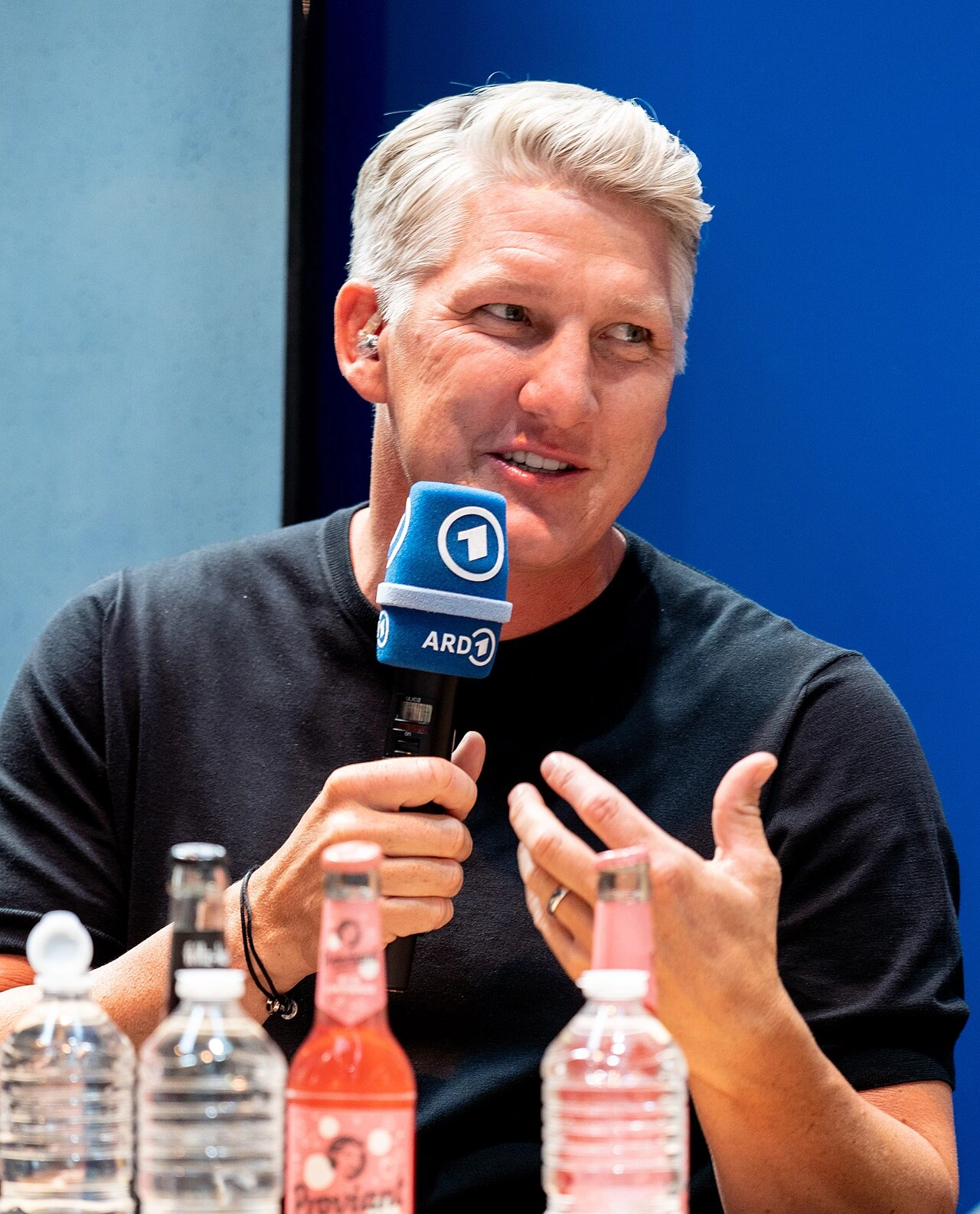
Since retiring in 2019, Schweinsteiger has become a regular TV analyst in Germany, most notably working with ARD and ZDF, the two main public broadcasters that cover major international tournaments. German media reporting from outlets including RND, t-online, and krone.at has investigated what these broadcasters pay their football experts, including Schweinsteiger. The figures cited in this coverage suggest per-tournament fees that can run into six figures for a major event like the Euros or the World Cup, though none of these are primary-source contract disclosures. It is steady, recurring income that adds meaningfully to his post-retirement financial picture without being the dominant driver.
Endorsements and brand deals
Forbes tracked Schweinsteiger's endorsements separately from wages in its 2014 and 2016 World's Highest-Paid Soccer Players lists. During his peak years, he held deals with Adidas (his long-term kit supplier), and various German and international brands. Post-retirement endorsement income typically shrinks compared to peak-career years, but players at Schweinsteiger's profile level often maintain brand relationships for years after stopping play. His marriage to tennis star Ana Ivanovic has also kept him in a dual-sport public spotlight that is commercially valuable. Exact current endorsement revenue is not publicly disclosed.
Ambassador roles
In 2017, Deutsche Welle reported that Schweinsteiger was named a German Football Ambassador, and separate DW coverage noted that Bayern Munich had hoped to use him in an ambassador capacity connected to their US operations around the time of his MLS move. Ambassador roles for elite players vary widely in compensation, from symbolic titles to six-figure annual retainers. No salary figure has been disclosed for Schweinsteiger's ambassador work, so it is not responsible to include a specific number, but the roles confirm that his professional engagement with football did not end when his playing career did.
Why different websites give you different numbers
This is probably the most useful thing to understand if you have already done some searching. The conflict between sites comes down to a few systematic problems. First, many sites confuse gross career earnings with net worth. They total up reported contract values, divide by nothing, and call it a net worth estimate. That ignores tax (often 45 to 50 percent in Germany and the UK), agent fees (typically 5 to 10 percent), and lifestyle costs over a 20-year career. Second, sites often copy each other rather than sourcing independently, so one speculative figure circulates and multiplies. Third, some sites use algorithm-generated estimates (like Capology) without flagging them as estimates, which gives false precision.
This is not unique to Schweinsteiger. You see the same pattern with German teammates from the 2014 World Cup squad. The Joshua Kimmich net worth page on this site works through the same problem for a current Bundesliga player, and the pattern of conflicting estimates is identical. The methodology for arriving at a reliable number is the same: anchor to verified wage records, apply realistic tax assumptions, and be explicit about what is and is not confirmed.
It is also worth knowing that Forbes' investigative process for calculating the net worth of the very richest people, as described in its Forbes 400 methodology, involves interviews, asset valuations, and significant cross-checking. That level of rigor does not get applied to a soccer player's Forbes list appearance, which is really a ranked income snapshot, not a full balance sheet.
Checking and updating the estimate today
If you want to verify or refresh this estimate yourself, here is the practical workflow.
- Start with MLSPA salary guides and PDFs for the Chicago Fire years. These are public documents. The 2019 MLSPA salary PDF includes Schweinsteiger's guaranteed compensation figure directly.
- Cross-reference MLS figures on Spotrac, which aggregates contract and salary data for MLS players and flags roster/transaction status updates alongside salary breakdowns.
- For the Bayern Munich and Manchester United years, use Forbes' World's Highest-Paid Soccer Players lists from 2014 and 2016 as the most citable reference points for income-era snapshots, and treat Capology figures as algorithmic estimates.
- Apply a realistic tax assumption. German top income tax was approximately 45 percent during his Bayern years. UK income tax for high earners is 45 percent. Illinois state income tax was around 4.95 percent during his MLS years, plus federal.
- Check recent German media outlets (RND, t-online, ARD/ZDF press releases) for any updated reporting on his TV analyst fees, particularly around major tournament windows.
- Do not treat any single celebrity finance site's headline figure as verified. Cross-check the underlying source, and if there is none cited, treat the number as a rough guess.
For a useful comparison of how similar careers translate into wealth for players who came up through the same era of German football, the Blaszczykowski net worth profile covers a contemporaneous Bundesliga player whose career arc and income sources share some parallels with Schweinsteiger's. Likewise, the André Schürrle net worth page looks at another 2014 World Cup winner whose post-career financial picture has been pieced together from similar sources.
The most defensible estimate, and what it is based on
Working from verified and citable sources: Schweinsteiger earned somewhere in the range of $60 million to $80 million gross across his Bayern Munich years at peak wages, roughly $15 million to $20 million gross at Manchester United, and approximately $14 million to $16 million gross across three MLS seasons. That gives a gross career total in the $90 million to $116 million range. After accounting for European income tax rates, agent fees, and the general cost of maintaining a high-profile career and lifestyle over 20 years, a realistic post-tax accumulated wealth figure lands in the $35 million to $45 million range before investment returns or property appreciation are factored in. Add modest but real post-retirement income from TV work and retained endorsements, and the $35 million to $40 million net worth figure is the most defensible estimate available with public information.
For players who were still active during Schweinsteiger's final years, the financial landscape looks different because wages have continued to rise sharply. The Martin Lewandowski net worth page and the Martin Skrtel net worth profile both illustrate how differently careers can monetize depending on tenure, peak timing, and the clubs involved, which is useful context for understanding why Schweinsteiger's estimate sits where it does relative to other players of his generation.
The honest bottom line: Schweinsteiger is comfortably wealthy by any measure, with a net worth most likely in the $35 million to $40 million range as of April 2026. That figure will not dramatically change unless new primary-source financial disclosures emerge, which is rare for retired European footballers. The sites quoting $80 million or more are almost certainly conflating gross career earnings with actual net worth, and the sites quoting $20 million or less are almost certainly underestimating his career wages. The $35 million to $40 million range is grounded in what the public record actually supports.
FAQ
Can Schweinsteiger’s net worth be higher than the $35M to $40M range? If so, what would need to be true?
Yes, but only within a limited range. Because there is no public balance sheet, the estimate can shift if you model taxes, living costs, agent fees, and post-career income differently. The article’s range assumes typical European tax brackets and standard fee structures, so dramatic swings usually come from using gross career earnings as if they were net worth.
Why do some websites produce numbers like $70M or $80M, while others land closer to $35M?
A lot. Different sites use different assumptions for after-tax income (tax rates, deductions, and timing), agent fees (often a percentage of contracts, not wages alone), and whether they treat signing bonuses as fully received upfront or distributed across the contract term. If a site skips these adjustments, it tends to inflate the number toward gross earnings.
What is the difference between “net worth” and “career earnings” in Schweinsteiger’s case?
Not exactly. Net worth is assets minus liabilities at a point in time, while “career earnings” is a total inflow over years. Even if two sites agree on career earnings, they can still disagree on net worth because of taxes already paid, spending, debt, and how much was saved or invested.
Can I compute Schweinsteiger’s net worth mostly from publicly available MLS salary numbers?
You can use the MLS documents discussed for his Chicago Fire years to tighten the floor for his MLS earnings, but you still cannot fully reconstruct his global net worth from MLS alone. Bayern and Manchester United wages are not provided in a comparable public, union-style document, so you would still rely on reputable snapshots (like income reporting during peak years) plus reasonable tax modeling.
How should I interpret the MLSPA “guaranteed compensation” figure so I do not overcount?
Be careful with “guaranteed compensation” wording. In the MLSPA context described, guaranteed compensation includes base salary plus annualized signing or guaranteed bonuses, and it excludes performance-based bonuses. If you accidentally add performance bonuses as guaranteed, you will overstate the MLS portion of his net worth.
Does Illinois having no state income tax materially change estimates for his Chicago Fire earnings?
It should affect the MLS portion and the overall estimate, but it will not change the headline range by itself. The article notes that Illinois has no state income tax, so only federal and Illinois taxes apply for those MLS years. In many models, that modestly improves after-tax retained wealth relative to states with income tax.
Could post-retirement TV and ambassador work push his net worth above the current estimate?
Yes, but usually as a secondary lever rather than the primary one. His TV analyst work and retained brand relationships can add recurring income, but the biggest driver of net worth is the capital accumulated during playing years (after tax). If you include post-retirement income too aggressively without verified figures, you risk inventing precision.
What are the main reasons the real net worth might be lower than the modeled estimate?
Potentially. If Schweinsteiger had unusually high personal costs, business expenses, or investments that lost value, net worth could be lower than a clean “income minus typical spending” model. Since there is no public disclosure of liabilities or investment performance, most estimates treat liabilities as minimal and spending as typical for a high-earning athlete.
How often should Schweinsteiger’s estimated net worth be updated, and what would change the number most?
Yes, but only if you have verifiable new disclosures. The article indicates that significant movement would require primary-source financial statements, which are rare for retired players. Otherwise, most sites keep recalculating the same public wage and income snapshots with different assumptions.
Is Capology a reliable source for Schweinsteiger’s net worth calculation?
A common mistake is to treat Capology-style numbers as confirmed instead of algorithmic. In the article’s framework, Capology can help triangulate patterns, but it should not be treated as a primary-source wage record when you are trying to estimate net worth with tighter confidence.
How can I compare Schweinsteiger’s wealth to other players without getting misled by inconsistent methods?
Yes, to an extent. If you compare him to contemporaries, use the same methodology (verified wages where possible, clear treatment of taxes and fees, and separation of endorsements and wages). Otherwise you can mis-rank players simply because one site is mixing gross earnings with net worth.
Next Articles
Bologna FC Net Worth: Club Value, Debt, Revenue Explained
Bologna FC net worth explained: club value, revenue, debt, and how to verify official figures vs estimates.
Sevilla FC Net Worth: How to Estimate Club Valuation
Learn how to estimate Sevilla FC valuation and financial position using source-based revenue, costs, debt, assets, and c

Napoli FC Net Worth Explained: Valuation, Debt, Owners
Napoli FC net worth breakdown: valuation vs equity, revenue, debt, wages, amortization, owners, and Serie A peer compari